Being a Bridge Between People
A Story about Trust, Responsibility, and Appreciation
My main career is working as a freelance tour guide, but tourism is not the only work I do. During the low season, or whenever I have free time between tours, I sometimes work as a freelance Khmer–Vietnamese-English interpreter. I also accept document-translation assignments from translation companies across Vietnam and occasionally provide on-site interpreting when someone needs help communicating in Vietnam or abroad.
Over the years, this side of my work has taken me into many different situations. I have translated documents, helped people communicate at hospitals, and accompanied clients on different assignments. Some jobs are simple and finish within a few hours. Others become much more personal because they involve people who are worried, under pressure, or far from home.
One of the most memorable was a five-day interpreting assignment in Phnom Penh, Cambodia, in September 2024.
An Unexpected Call
One morning in September 2024, I received a phone call from an agent of a translation company I had worked with before.
The message was urgent.
A family from the Mekong Delta needed a Khmer–Vietnamese-English interpreter to accompany them to Phnom Penh. They were already on their way from the Mekong Delta to Tan Son Nhat Airport in Ho Chi Minh City.
The plan was to fly from Ho Chi Minh City to Phnom Penh as soon as possible.
They expected me to meet them at the airport only a few hours later.
After speaking with them briefly, however, I had a feeling that flying might not be the best option.
The family was from a small town and did not have much experience with international flights. They were understandably in a hurry because a loved one had suddenly become seriously ill in Phnom Penh.
Their priority was not sightseeing or finding the most convenient flight.
They simply wanted to get to Cambodia as quickly as possible.
I already knew that flights between Ho Chi Minh City and Phnom Penh did not operate continuously throughout the day, so I prepared myself mentally for another possibility.
I suspected we might have to travel by road.
And that was exactly what happened.
From Ho Chi Minh City to the Cambodian Border
After meeting the family, we checked the flight situation and quickly realized that there was no suitable flight for us.
There was no time to waste.
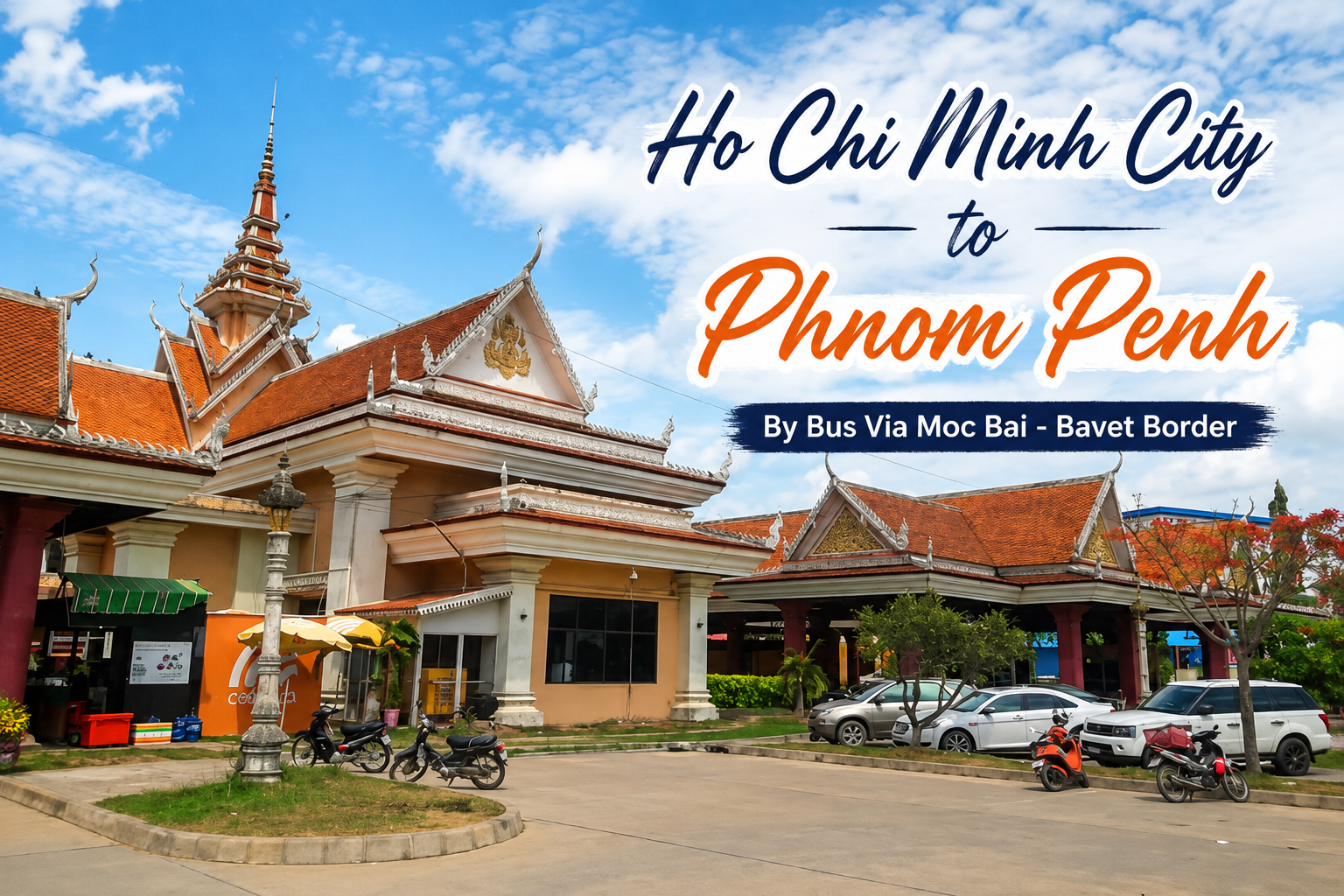
We arranged a private car and headed toward the Cambodian border.
Our first destination was Trảng Bàng in Tây Ninh Province, a small town roughly 20 kilometres from the border.
By the time we arrived, it was already getting dark.
Rather than continuing late into the night, we decided to spend one night there and continue the journey the following morning.
There was an additional complication.
Only the wife would continue across the border with me. Her husband, a Taiwanese man, was already in Phnom Penh, where he had become seriously ill and was being treated in hospital.
She was understandably worried.
She was travelling to a foreign country to look after her husband while having to deal with a language barrier and an unfamiliar healthcare system.
That was where my role became much more than simply translating words.
Crossing Into Cambodia
The following morning, the two of us travelled to the border and completed the procedures to enter Cambodia.
From there, a private car took us directly toward Phnom Penh.
The woman’s husband was a senior engineer working on construction projects in Phnom Penh. Because of his position and importance to the company, the company was directly involved in helping him after he suddenly became seriously ill.
We were heading straight to the hospital.
I knew that once we arrived, my job would become much more serious.
There would be medical staff.
There would be company representatives.
There would be questions.
And most importantly, there would be a worried wife who needed to understand what was happening to her husband.
Arriving at Royal Phnom Penh Hospital
When we finally arrived in Phnom Penh, we went directly to Royal Phnom Penh Hospital.
My first impression surprised me.
I had previously done some translation work at hospitals in Vietnam, including places such as FV Hospital, Tam Duc Hospital, and Nam Sai Gon International General Hospital. So I already had some experience with private hospitals.
But when I first walked into Royal Phnom Penh Hospital, I was impressed by the environment.
It was extremely clean, modern, and comfortable.
At some moments, when I was not needed for interpreting, sitting in the reception area almost felt like sitting in a high-end hotel rather than a hospital.
Of course, behind that comfortable public area was a much more serious situation.
Her husband was unconscious inside the emergency department.
My First Conversation at the Hospital
I was the person who first contacted someone at the hospital.
A man soon appeared and took us toward the emergency area.
The woman immediately began asking questions.
What had happened?
What was the cause?
When did his condition begin?
What was the hospital doing?
Her husband remained unconscious inside.
We stood outside the room, communicating through the window and waiting for information.
My job was to help both sides understand each other.
At first, I thought the couple who came to speak with us were nurses or medical staff responsible for caring for the patient.
I greeted them and helped translate their conversation.
Only later did I discover something quite different.
They were actually a husband-and-wife couple who managed the construction company where the patient worked.
That explained why they were personally involved.
The patient’s contribution to the company was clearly valued, and when he suddenly became seriously ill, the company’s management came directly to the hospital to help.
A Lesson About Professionalism and Appreciation
That part of the experience stayed with me.
The patient was an employee.
But he was not treated simply as an employee.
His contribution to the company had clearly been remembered.
When he needed help, the company’s management did not simply leave everything to someone else. They came personally and helped his wife deal with an unfamiliar situation.
It reminded me of something I have learned through my own working life:
When you contribute something valuable to other people, your work can stay in their memory long after the job itself is finished.
Sometimes that appreciation appears when you least expect it.
Five Days of Going Back and Forth
I stayed in Phnom Penh for five days.
The hotel where I stayed was Indra Hotel, about three kilometres from Royal Phnom Penh Hospital.
The daily routine became quite simple.
Every morning, a private car arranged by the couple came to pick us up and take us to the hospital.
We would spend the morning there, return to the hotel around lunchtime, and then go back to the hospital again in the afternoon.
The routine repeated itself for several days.
I had very little free time.
Even when there was nothing for me to translate at a particular moment, I did not want to go too far away.
I knew the family might suddenly need me.
So I stayed close to the hotel and hospital.
That was an important part of the job.
An interpreter in a situation like this cannot simply say, “My work is finished for today.”
You need to remain available because circumstances can change quickly.
A Worried Wife Far From Home
The most important person I was helping was the patient’s wife.
She was alone in a foreign country, dealing with a very stressful situation.
She had travelled from Vietnam to Cambodia because of her husband, but she did not speak the local language fluently.
Even travelling between the hotel and hospital could make her nervous.
I understood her concern.
If something unexpected happened, she needed someone who could communicate immediately with the hospital staff or the people helping her.
That was why I took the responsibility seriously.
My job was not to make medical decisions.
I was not a doctor.
I was not there to give medical advice.
My role was simply to help her understand and communicate.
But sometimes that simple role can make a big difference when someone is under stress.
Phnom Penh Through a Very Small Window
Normally, when I visit Phnom Penh, I enjoy exploring the city. I have actually been there many times before.
As someone who works in tourism, I naturally like walking around, taking photographs, trying local food, and observing everyday life.
This trip was completely different.
I was in Phnom Penh for five days, but I hardly had the chance to explore.
The hotel and hospital were my two main destinations.
Whenever I had a little free time, I might find a coffee shop nearby.
I also managed to meet a few friends who work as tour leaders and sometimes bring tourists between Cambodia and Vietnam.
We had a quick coffee or conversation whenever our schedules allowed.
That was about as much sightseeing as I managed to do.
But that was perfectly fine.
I was not in Phnom Penh as a tourist.
I was there because someone needed my help.
When the Job Became Easier
After several days, the situation became more stable and communication became easier.
By the fifth day, I started thinking that perhaps they no longer needed me as much as they had in the beginning.
Keeping me in Phnom Penh meant additional costs for my hotel, transportation, and interpreting service, as the assignment was arranged and paid for through a translation company.
I felt it would be better to help them find another solution.
So I spoke with both sides and suggested finding a local bilingual person who could continue helping them communicate.
The family actually wanted me to stay longer.
The wife, in particular, was still worried about travelling between the hotel and hospital without someone she trusted.
I tried to reassure her.
I explained that the situation appeared more stable and that she would be able to manage with local support.
Eventually, she agreed.
So after five days, I prepared to return to Ho Chi Minh City.
Leaving With a Good Feeling
When I left Phnom Penh, I felt that I had done what I was supposed to do.
I had arrived at a moment when the family urgently needed help.
I had helped her communicate with the hospital and the people involved.
And once the situation became more manageable, I stepped aside so someone local could continue helping her.
For me, that was a successful assignment.
Not because I stayed for a long time.
Not because I earned a good fee.
But because the person who needed my help was able to feel a little more comfortable and confident in a difficult situation.
Thank You to the People Who Trust My Work
I also want to take this opportunity to mention two translation companies that have given me many opportunities over the years: A2Z and PLG.
I have done quite a lot of work for both companies, including document translation and on-site interpreting in Vietnam and Cambodia.
Interestingly, we have never actually met face-to-face.
Modern technology has made that possible.
They can simply call me or send me a message.
We discuss the assignment, I accept the job, complete the work, and report back.
Over time, even without meeting in person, regular communication through phone calls and messages has created a sense of trust.
They trust me with their assignments.
And I understand that when they give me a job, I have a responsibility to complete it properly.
When Companies Trust You With More Than Guiding
The same is true in tourism.
There have also been occasions when a travel company has trusted me with something much more important than guiding.
Some travel companies do not have a representative or branch in the destination where I am working. Because of that, they sometimes ask me to collect tour payments from tourists on their behalf and transfer the money back to the company later.
On some occasions, the amount has been several thousand US dollars.
That is a serious responsibility.
When a company trusts you with that kind of money, the relationship is no longer simply about being a guide who knows the attractions and restaurants.
It is about honesty, responsibility, and professional trust.
I hope that one day they might read this story.
If they do, I would simply like to say:
Thank you for trusting me.
Good Work Is Remembered
There is something else about this story that I think is worth sharing.
Good work is remembered.
The patient had worked devotedly for the company. When he suddenly became seriously ill, the company’s management personally came to the hospital to support him.
That made a strong impression on me.
His work had earned their trust and appreciation.
And when he needed help, that trust came back to him.
I have experienced something similar in my own work.
I try to return that trust by doing the job carefully and responsibly.
That is the kind of service I want The Son Mekong to represent too: honest, practical, and based on real experience.
Final Thoughts
This five-day trip to Phnom Penh was not a holiday.
I did not have much time to explore the capital.
I did not spend my evenings walking around the city.
But it is still one of the trips I remember clearly.
It reminded me why trust matters in service work.
That was the real value of my job.
Every assignment has a story.
This was one of mine.
I see these different jobs as part of my journey rather than completely separate careers.
Every job has taught me something.
Every assignment has introduced me to different people.
And every experience has added another chapter to my story.
Thank you for reading.
If You Need a Khmer–Vietnamese-English Interpreter
If you are a Vietnamese traveller, family, businessperson, or company that needs Khmer–Vietnamese-English interpreting in Cambodia, I am happy to discuss the assignment whenever I am available.
I can potentially help with situations such as:
- Hospital visits and communication
- Business meetings
- Construction-site communication
- Travel between Vietnam and Cambodia
- On-site interpreting
- General Khmer–Vietnamese communication
- Document-related communication
- Assistance for Vietnamese visitors who are unfamiliar with Cambodia
I cannot guarantee availability because tour guiding remains my main work, but when I am free, I am happy to consider the assignment.
If you need this kind of service, you can contact me through The Son Mekong and tell me what you need, where you need it, and when. I accept assignments whenever my tour schedule allows.
Thank you very much.