Cambodia- A 7-Day Journey from Vietnam
There are some journeys we take because we want to see famous places.
And then there are journeys we take because something inside us tells us to go.
This was one of those journeys.
After years of working as a freelance tour guide in southern Vietnam, I had crossed the Vietnam–Cambodia border many times. I had taken tourists to the border, helped them with their journeys, and watched buses leave Ho Chi Minh City for Phnom Penh. I had also seen speedboats depart from Chau Doc for Phnom Penh.
But there was one thing I had never done myself:
I had never crossed between Vietnam and Cambodia by water (Speedboat).
That small gap in my own travel experience kept making me curious.
So, after leaving my official guiding job at a daily tour company in May 2019, I decided to take some time to discover things for myself before beginning another chapter in my working life.
Why I Wanted to Explore Cambodia This Way
Before talking about the journey itself, there is a little background that explains why this trip became important to me.
In May 2019, I stopped working as an official guide for a travel company based in Ho Chi Minh City. The company was well known for organizing daily tours, and it was a very busy operation.
Its tourists came mainly from three sources:
- Direct bookings through the company’s own staff.
- Travel companies from across Vietnam and overseas partners.
- Online booking platforms such as Klook, KKday, GetYourGuide, and TripAdvisor.
On a normal day, the company could organize anywhere from several buses to 10 or even 20 buses, depending on the season.
The tours covered many destinations around southern Vietnam.
There were Ho Chi Minh City half-day and full-day tours, Cu Chi Tunnels, Cao Dai Temple, Mekong Delta, Vung Tau, and Can Gio.
There were also longer Mekong Delta trips: two-day tours from Saigon to My Tho and Can Tho, and three-day journeys from Ho Chi Minh City → My Tho → Can Tho → Chau Doc → Ho Chi Minh City or Chau Doc →connected with Phnom Penh, Cambodia.
I worked on these daily tours for more than two years, with a full schedule through almost every season.
Sometimes, in one month, I did the three-day Mekong Delta tour two or even three times.
A typical three-day trip started from Ho Chi Minh City and continued to My Tho, Can Tho and Chau Doc. After visiting the floating market, a rice noodle workshop and the countryside around Can Tho, we continued toward Chau Doc.
The following morning of day 3, we explored the fish farms and Cham village, and a Muslim Mosque before returning to Ho Chi Minh City.
But some tourists did not return to HCM city with us.
They continued their journey to Phnom Penh by speedboat.
That was the part that caught my attention.
The Speedboat I Had Seen So Many Times
I had taken tourists to the speedboat station in Chau Doc nearly a hundred times.
I knew the routine. I knew that the journey to Phnom Penh by river took roughly five hours, including the border formalities.
A typical departure was around 7:00–7:30 in the morning from Chau Doc, arriving in Phnom Penh around lunchtime.
But I had never actually sat on that boat. I was always the guide sending my tourists off.
So I became increasingly curious. I thought:
“Why am I explaining an experience to travelers that I have never personally experienced?”
I wanted to experience it myself.
From Tour Guide to Traveler
I had already traveled between Vietnam and Cambodia many times, mainly by road and air.
But traveling between the two neighboring countries by waterway was still new to me.
So I decided to combine the things I already knew with something I had never personally experienced.
That became my seven-day solo Cambodia trip.
My plan was simple:
Ho Chi Minh City → Phnom Penh → Siem Reap → Battambang → Poipet → Phnom Penh → Chau Doc
I would travel mostly by bus during the first part of the journey and return to Vietnam by speedboat.
Following the Voice of My Heart and Soul
As Khmer Son, and Khmer music has always been part of my life.
I have listened to old Khmer songs by legendary singers such as Sin Sisamuth, Ros Sereysothea, and Pen Ran for many years.
Sometimes I play Khmer oldies quietly when I want to relax. Sometimes I listen to them before falling asleep.
Over the years, their songs created images in my mind of Cambodia: its towns, rivers, countryside, old buildings, temples, and everyday life.
So when I finally decided to travel around Cambodia alone, I did not want to follow only the most popular tourist itinerary.
I wanted to follow the voice of my heart and soul.
I wanted to see with my own eyes some of the places I had already imagined through Khmer oldie songs, books, stories, social media, and memories.
That was another reason behind this trip.
My 7-Day Cambodia Journey
I eventually designed a route that would combine bus travel, local exploration, and the Mekong River speedboat.
My plan was:
| Day | Route | Overnight |
|---|---|---|
| Day 1 | Ho Chi Minh City → Phnom Penh by bus | Phnom Penh |
| Day 2 | Phnom Penh → Siem Reap | Siem Reap |
| Day 3 | Explore Siem Reap and Angkor area | Siem Reap |
| Day 4 | Siem Reap → Battambang | Battambang |
| Day 5 | Explore Battambang → Poipet | Poipet |
| Day 6 | Poipet → Phnom Penh | Phnom Penh |
| Day 7 | Phnom Penh → Chau Doc by speedboat | Chau Doc / Vietnam |
Day 1: Ho Chi Minh City to Phnom Penh by Bus
My journey began in Ho Chi Minh City.
Instead of flying, I chose the bus.
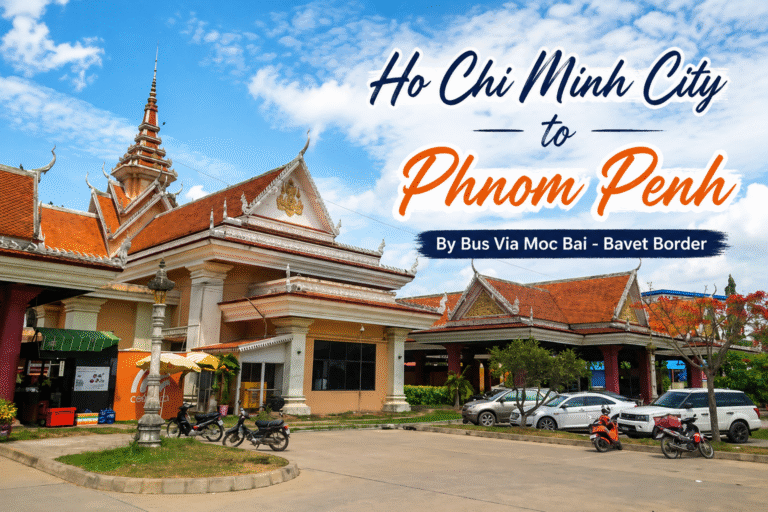
There was something meaningful about starting the journey overland. The road took me toward the Moc Bai–Bavet international border, a border crossing I already knew very well from my years working with tourists.
This time, however, I wasn’t standing beside a tour bus as a guide. I was a traveler. I had passed through this area countless times while picking up or sending off tourists. Now I was crossing the border for my own journey.
The experience felt different.
After crossing into Cambodia, I continued toward Phnom Penh. I spent the night in the Cambodian capital.
Day 2: Phnom Penh to Siem Reap
The next morning, I continued north toward Siem Reap.
This was another long road journey, but I enjoyed watching the Cambodian countryside change outside the window.
For me, traveling by road was part of the experience. Flying would have been faster, but I wanted to feel the distance between the places.
I arrived in Siem Reap and spent the night there. This was my base for the next day’s exploration of Angkor.
Day 3: Exploring Angkor in My Own Way
Of course, Angkor Wat was one of the main reasons I came to Siem Reap. But I approached the day differently from the traditional tour itinerary I had used with tourists.
I explored by tuk-tuk and followed my own interests. I visited Srah Srang, the large ancient reservoir opposite Banteay Kdei.
The atmosphere there was different from standing in front of the famous Angkor Wat.
It felt quieter and more open.
Watch my video: Srah Srong, Angkor Wat — A Trip to Cambodia
I also visited the wax museum at Cambodian Cultural Village, where the displays offered another perspective on Cambodian history and cultural figures.
For me, these places were not simply tourist attractions. They helped connect the Cambodia I had imagined through stories, music, and books with the Cambodia I could finally see in person.
Watch my video: Wax Museum in Cambodian Cultural Village, Siem Reap
I also recorded another video there:
Watch another video from the Cambodian Cultural Village Wax Museum
Day 4: Siem Reap to Battambang
After Siem Reap, I continued west to Battambang.
This was another place I had been curious about for a long time.
It had a special place in my imagination because of the Khmer oldie songs I grew up listening to.
For me, though, Battambang was not simply another destination on a map. It was a place I had wanted to see for a long time.
I spent the night in Battambang.
Day 5: Exploring Battambang — A Place I Knew Through Songs
It was a place that already existed in my imagination through Khmer oldie songs that I often played when I wanted to relax or even lull myself to sleep—particularly songs by Sinn Sisamouth, Ros Sereysothea, Pan Ron, and other legendary singers.
I was particularly curious about Lok Ta Dambong Kra Nhoung, Dong Stung Sangker, and Wat Damrei Sor. I wanted to see these places with my own eyes rather than only imagine them while listening to those old songs. So when I arrived in Battambang, I was looking for the places behind the songs.
Watch my video: Stung Songkea, Battambang — A Trip to Cambodia
Poipet: Just to See It
After exploring Battambang, I continued toward Poipet in the afternoon.
My purpose was quite simple. I just wanted to see this border city for myself.
Poipet is an important gateway between Cambodia and Thailand, and it has a very different atmosphere from the more relaxed cities I had visited earlier.
I spent the night in Poipet.
For me, this was not about ticking another tourist attraction off a list.
It was about understanding Cambodia from another angle.
Day 6: Poipet to Phnom Penh
The following day, I traveled from Poipet back toward Phnom Penh.
After several days on the road, I returned to the capital again.
This was also an important part of the journey because I needed to prepare for the final and most exciting section:
Phnom Penh to Chau Doc by speedboat.
This was the part I had been curious about for years.
Day 7: Phnom Penh – Speedboat to Chau Doc
Phnom Penh — A Familiar City Seen Differently: By the seventh day, I was back in Phnom Penh again. In fact, Phnom Penh was not a new destination for me at all. I had already been to the capital more than ten times for work as a tour leader, bringing Vietnamese tourists to Cambodia and taking them around the city’s main attractions.
My final day in the kingdom began with a short exploration of its capital. I visited the National Museum of Cambodia, one of the city’s most important cultural institutions in the morning.
The museum houses an extensive collection of Khmer cultural material, including sculpture, ceramics, and objects from prehistoric, pre-Angkorian, Angkorian, and post-Angkorian periods.
Watch my video: National Museum of Cambodia, Phnom Penh
After the museum, I headed toward the riverside and arrived at the speedboat station – International Floating Port, 103 Sisowath Quay, Phnom Penh earlier than the departure time.
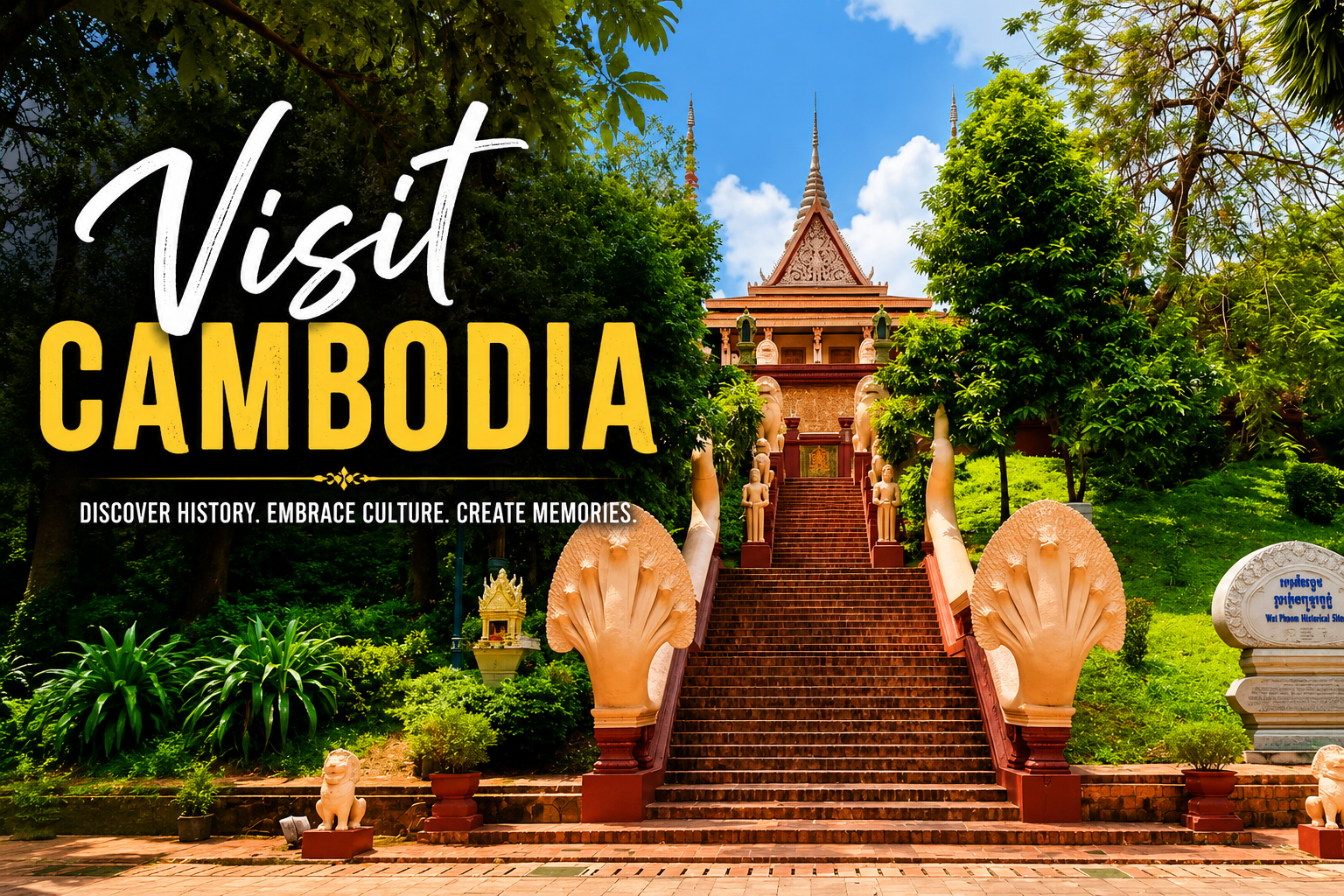
I checked in for the speedboat and left my luggage at the station. With some free time remaining, I walked over to Wat Phnom, the historic temple that gave Phnom Penh its name, before returning to the riverside.
Watch my video: Wat Phnom, Phnom Penh — A Trip to Cambodia
Wat Phnom: The Hill That Gave Phnom Penh Its Name
According to the traditional legend, a woman named Penh discovered four Buddha statues that had been brought by the river. A temple was later established on the hill, and the story became associated with the name Phnom Penh. The word “Phnom” means “hill” in Khmer, while “Penh” refers to the woman in the legend.
Over time, Phnom Penh became the name of the city that grew around the hill.
I made a short visit, looked around, and then returned to the riverside.
And then came the part I had been waiting for since I first became curious about this route years earlier.
I was finally going to take the Phnom Penh–Chau Doc speedboat myself.
The Phnom Penh to Chau Doc Speedboat
This was the highlight I had been waiting for.
I had sent tourists onto this boat many times. Now I was finally going to sit on it myself.
The boat left Phnom Penh and began moving along the river.
For the next several hours, I could simply watch:
The river.
The houses.
Boats.
Fishing activity.
People living along the banks.
Changing landscapes.
And eventually, the border.
Current Victoria Speedboat information lists the Phnom Penh–Chau Doc service at 1:30 PM and describes the journey as approximately five hours. The reverse Chau Doc–Phnom Penh service is listed at 7:00 AM.
Current service conditions, schedules, and minimum passenger requirements should always be checked directly before booking.
Victoria Speedboat – Chau Doc to Phnom Penh
Crossing the Vietnam–Cambodia Border by River
Eventually, we reached the border area.
This was the part I had been most curious about.
The river crossing uses the Song Tien/Vinh Xuong side in Vietnam and Kaam Samnor on the Cambodian side, connecting the Chau Doc area with Cambodia by water.
When we reached the border, all passengers had to leave the boat for immigration procedures.
On my trip, the boat staff handled much of the process.
We showed our documents, completed the required procedures, and waited.
After roughly twenty to thirty minutes, we returned to the boat.
Then the journey continued.
That was it.
But for me, it was a big moment.
I had finally experienced something that I had previously only explained to tourists.
Back to Chau Doc
After continuing along the river, eventually, the boat reached Chau Doc, my familiar mountain town in the Mekong Delta.
The boat journey came to an end near the riverside.
I was back in Vietnam. My seven-day Cambodia journey at a Glance had finished.
I had traveled:
Ho Chi Minh City → Phnom Penh → Siem Reap → Battambang → Poipet → Phnom Penh → Chau Doc
And I had done it by combining bus, tuk-tuk, and speedboat.
Why the Speedboat Was So Important to Me
For another traveler, the speedboat might simply be a convenient way to get from Cambodia to Vietnam.
For me, it meant something more.
For years, I had told tourists about this journey. I had taken them to the departure point. I had watched them leave.
I had read about the journey. I had researched the route.
But I had not experienced it myself.
After this trip, I no longer had to rely only on information from books or online research.
I knew what it felt like to sit on the boat. I knew what the river looked like. I knew what happened at the river border.
I knew what it felt like to finally arrive in Chau Doc.
That experience became part of my knowledge as a guide.
And this is one of the reasons I believe real travel experience matters.
Plane, Bus or Speedboat Between Cambodia and Vietnam?
For travelers planning their own trip, both options have advantages.
| Option | Best for | Main advantage |
|---|---|---|
| Bus | Budget travelers | Usually practical and straightforward |
| Flight | Travelers short on time | Fastest option |
| Speedboat | Experience seekers | A unique Mekong River journey |
| Private transfer | Couples/families | More flexibility |
The speedboat is not necessarily the fastest or easiest choice.
You should choose it because the journey itself interests you.
Current operators continue to advertise the Chau Doc–Phnom Penh service, but schedules, prices, and border procedures can change, so check directly before booking.
For example, the official Cambodian e-Visa website currently provides updated information about entry requirements and border entry points. It also states that travelers should complete the Cambodia e-Arrival before arrival.
Important: Do not rely on an old travel blog for visa or border information. Check the official government information shortly before your trip.
Official Cambodia e-Visa and e-Arrival information
Final Thoughts: Sometimes You Need to Travel for Yourself
When I look back at this journey, I don’t remember it simply as a seven-day Cambodia itinerary.
For years, I had been the person standing beside tourists, explaining where they were going and helping them continue their journey.
I had watched passengers leave Chau Doc by speedboat for Phnom Penh.
I had watched buses cross the Vietnam–Cambodia border.
I had explained places I knew from experience.
But eventually, I wanted to become the passenger.
I wanted to sit down, look through the window, listen to the sounds around me, and experience the journey without having to explain anything to anybody.
And I wanted to see with my own eyes some of the places I had already imagined through Khmer oldie songs, books, stories, social media, and memories.
That is why this trip happened.
It was not the fastest way to travel.
It was not the most comfortable itinerary.
But it was my journey.
And sometimes, that is the best reason to travel.
My Videos From This Journey
These videos fit the story naturally and would make excellent supporting material inside the article:
- Vietnam–Cambodia International Border: Watch the video on YouTube
- Srah Srang, Angkor Wat: Watch the video on YouTube
- Cambodian Cultural Village Wax Museum: Watch the video on YouTube
- Another Cambodian Cultural Village video: Watch the video on YouTube
- Stung Sangker, Battambang: Watch the video on YouTube
- National Museum of Cambodia: Watch the video on YouTube
- Wat Phnom: Watch the video on YouTube
5 Alternative SEO-Friendly Titles
- My 7-Day Cambodia Trip by Bus and Speedboat
- Cambodia by Bus and Boat: My Solo Travel Story
- A 7-Day Cambodia Adventure from Vietnam
- Vietnam to Cambodia by Bus and Mekong Boat
- My Cambodia Journey: Bus, Tuk-Tuk and Speedboat
A small editorial note
I think the strongest part of this article is not actually the itinerary. It is the personal reason behind it:
You had spent years sending tourists on the Chau Doc–Phnom Penh speedboat, but had never experienced it yourself.
That gives the story a very natural beginning, middle, and ending:
Guide → curious about the experience → becomes a traveler → takes the speedboat himself → returns with real experienc