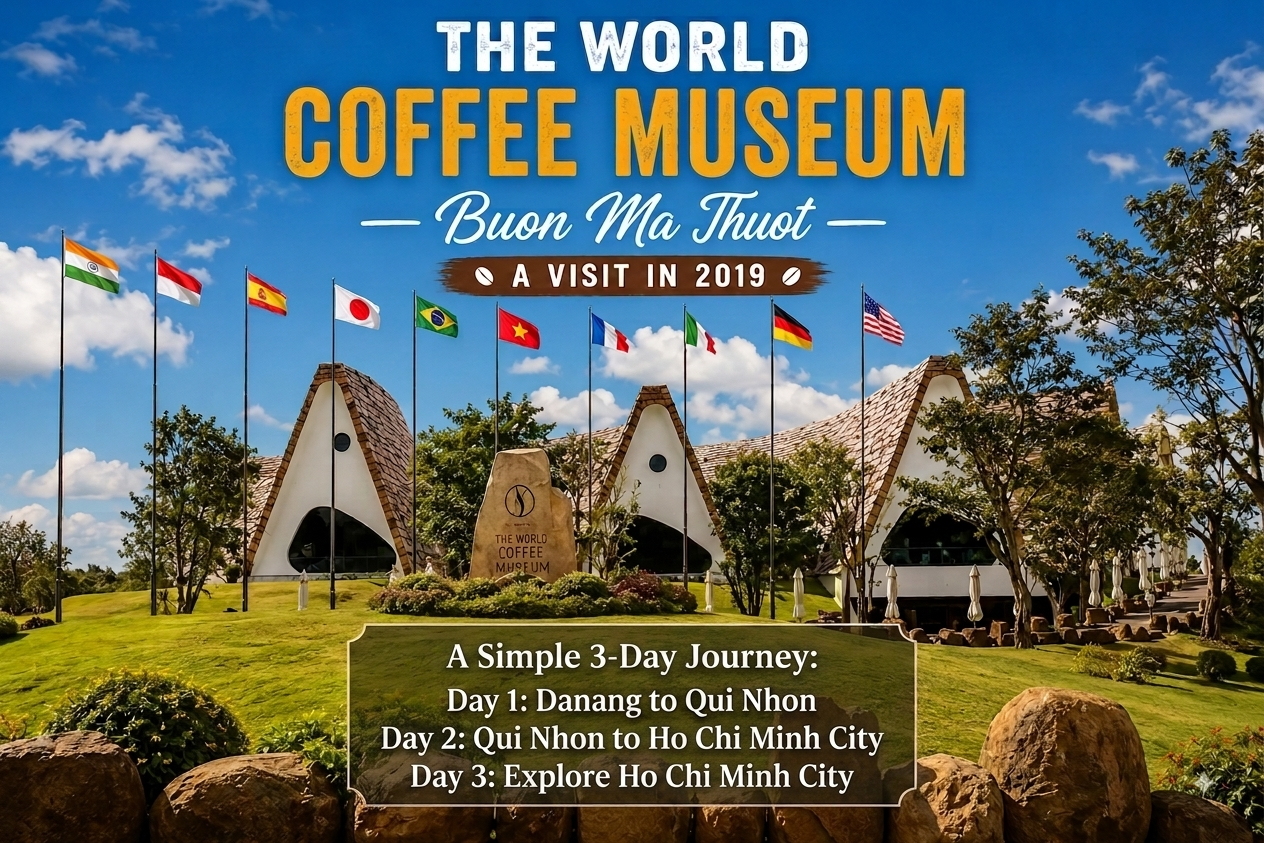
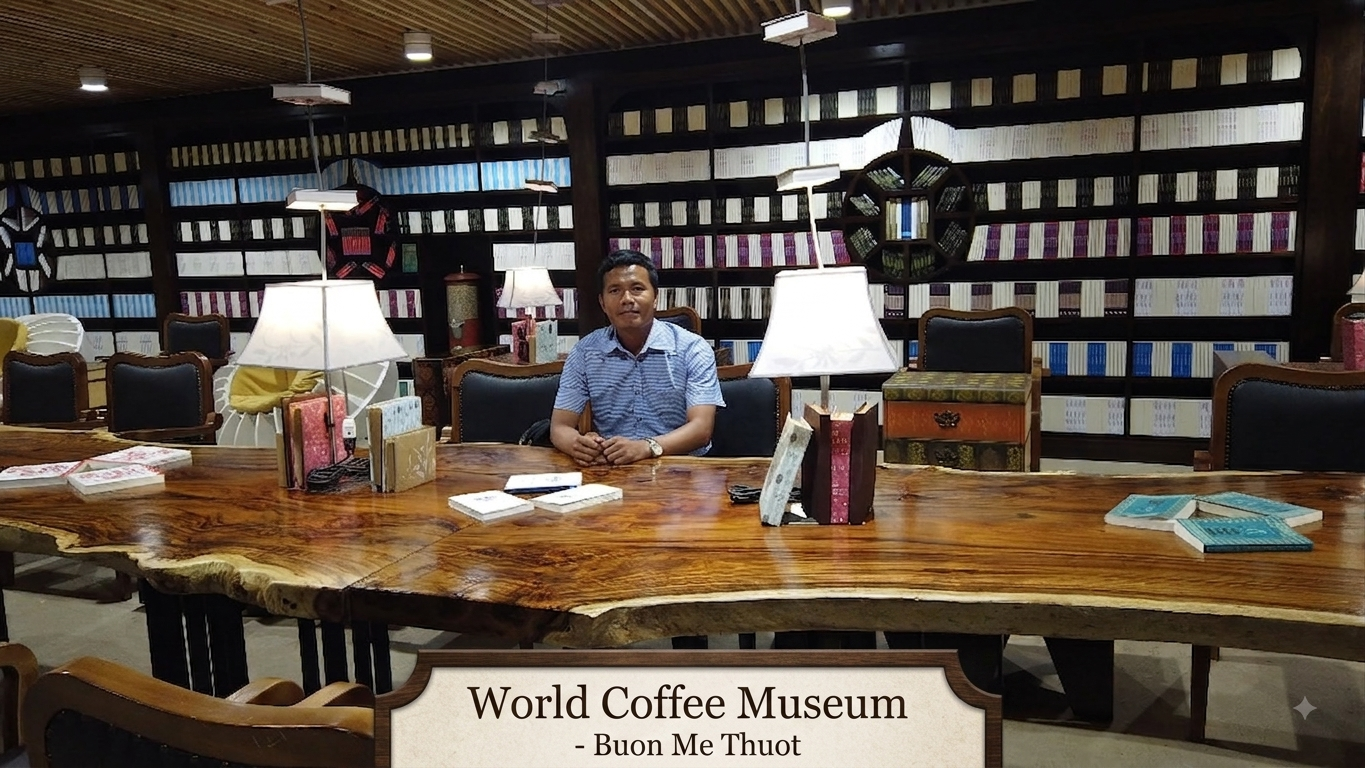
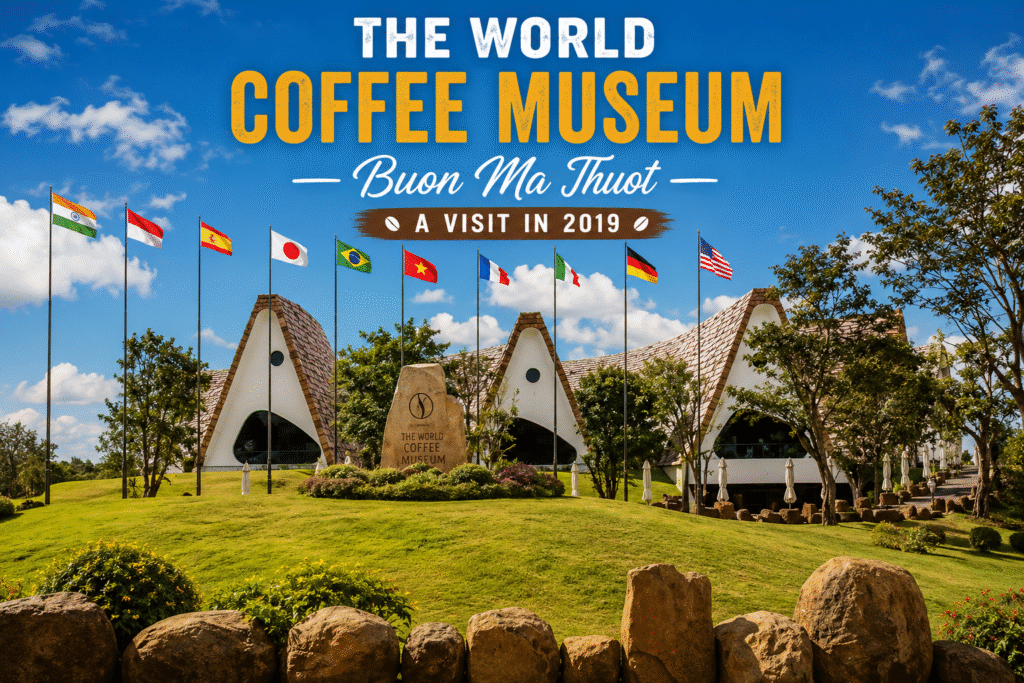
The next morning in Buon Ma Thuot, I visited the World Coffee Museum.
I honestly did not know exactly what to expect.
I imagined a conventional museum with glass cases, old photographs, and information boards.
Instead, the building itself surprised me.
The architecture is inspired by the long-house traditions of Central Highlands ethnic communities, and the museum combines architecture, objects, exhibitions, and coffee culture in a more open and contemporary way.
From outside, the building immediately catches your attention.
The curved forms and dark structure look quite different from the surrounding city.
I remember walking around the outside first and thinking:
“This is not what I expected a coffee museum to look like.”
Then I went inside. The exhibition spaces were equally interesting.
There were coffee-related objects and displays from different cultures, together with information about coffee history and the development of coffee culture.
What I liked most was that the museum did not make me feel as though I was simply walking through a collection of old objects.
It tried to make coffee feel like a living part of human culture. And that was exactly what I wanted to understand.
You can also watch my own video from the visit above
Why Vietnamese Coffee Is So Special to Me
Vietnamese coffee is not just a drink. For many visitors, the first surprise is the strength.
Traditional Vietnamese coffee is often brewed slowly through a small metal filter called a phin. The coffee drips directly into the glass or cup below.
Then comes the condensed milk.
For many first-time visitors, cà phê sữa đá—Vietnamese iced coffee with condensed milk—is the easiest place to start.
It is strong, sweet, cold, and refreshing, especially in Vietnam’s hot weather.
But Vietnamese coffee culture is much bigger than one drink.
You can find:
- Cà phê sữa đá — iced coffee with condensed milk
- Cà phê đen đá — black iced coffee
- Cà phê đen — black coffee
- Bạc xỉu — a milkier, gentler coffee
- Coconut coffee
- Salt coffee
- Egg coffee
- Modern specialty coffee
- Robusta-based traditional coffee
And then there is the experience of drinking it.
A Vietnamese café can be anything from a modern specialty coffee shop to a few tiny plastic chairs on a pavement.
You might pay very little for a cup and spend an hour sitting there.
Nobody is in a hurry. That is part of the culture.
Vietnam’s Coffee Country Is More Than Buon Ma Thuot
Buon Ma Thuot is perhaps the place most closely associated with Vietnamese coffee, but coffee is grown in several parts of the Central Highlands.
For travelers, a visit to the Central Highlands means that coffee can become part of a larger journey.
You can see the plantations. You can see coffee cherries growing on the trees.
You can stop at local cafés. You can visit a coffee museum.
And, of course, you can drink coffee almost anywhere.
For me, that makes coffee one of the best ways to connect with the Central Highlands.
And What About Tea?
Although this story is mainly about coffee, I cannot talk about travelling through Vietnam’s plantation areas without mentioning tea.
The two often appear together in my travel memories.
When I lead tours between Ho Chi Minh City and Da Lat, for example, I regularly pass through areas where visitors can see tea and coffee plantations.
So when you travel through the Central Highlands, you may see a landscape that changes from coffee to tea and back again.
That is something I particularly enjoy about road travel.
From an airplane, you see the landscape as a picture. From a bus, you gradually see it change.
My Favourite Coffee Stops Are Sometimes the Simplest
After visiting the museum, I did not immediately rush to another attraction.
I went back into the city and found another coffee shop.
I sat down. I drank coffee and watched local life.
This may sound like a very simple travel experience, but after years of guiding tours, I have learned that simple moments often become the strongest memories.
I did not need another five attractions. I had already found the main thing I was looking for.
I wanted to understand why coffee is so deeply connected with this part of Vietnam.
And sitting in Buon Ma Thuot, surrounded by cafés and people going about their daily lives, gave me part of the answer.
Coffee here is not just something produced for export.
It is part of everyday life.
Day 3: Buon Ma Thuot to Ho Chi Minh City
In the afternoon, I caught a bus back toward Ho Chi Minh City.
My three-day, two-night journey was coming to an end.
I had travelled from the coast, through the mountains, and into one of Vietnam’s most important coffee regions.
It was only a short trip. I did not see everything. I did not visit every attraction.
But I saw enough to make me want to come back.
And perhaps that is what good travel should do.
It should leave you with a few memories and a reason to return.
For me, those memories are connected to Quy Nhon’s beach, a quiet coffee shop, the long road through the Central Highlands, the architecture of the World Coffee Museum, and the taste of Vietnamese coffee.
If I had taken the plane, I would have reached Saigon much earlier.
But I would have missed the story.
Why I Chose the Bus Instead of the Plane
If I had taken the flight from Da Nang to Ho Chi Minh City, I would have arrived home quickly.
Instead, I spent three days travelling.
Was it more comfortable? No.
Was it faster? Definitely not.
Was it worth it? For me, absolutely.
The bus allowed me to see parts of Vietnam that I would never have experienced from an airplane.
I saw the road. I saw towns. I saw the coastline. I saw the countryside change.
I stayed overnight in Quy Nhon. I travelled into the Central Highlands.
I visited a museum I had never visited before. I drank coffee in two different cities.
And I came home with a story.
That is the difference between transportation and travelling.
If you prefer to travel independently, this kind of journey can be arranged using local buses or booking plaforms, depending on the route and season.
For travelers who prefer organized experiences, you can also compare Vietnam activities and tours through GetYourGuide or Klook….
What I Would Recommend to Coffee Lovers
If you are visiting Vietnam and love coffee, don’t only look for famous cafés in Hanoi or Ho Chi Minh City.
Try to see where the coffee comes from.
If your itinerary allows, consider adding Buon Ma Thuot or another Central Highlands destination to your journey.
A coffee-focused trip could include:
- A coffee plantation
- A local coffee farm
- The World Coffee Museum
- A traditional Vietnamese café
- A coffee roasting experience
- A local market
- A Central Highlands cultural experience
You don’t need to become a coffee expert. Just take your time. Ask questions. Try different brewing styles.
And most importantly, drink it the Vietnamese way at least once.
Want to Bring the Taste of Vietnam Home?
Vietnamese Coffee Products
- Vietnamese Robusta coffee beans
- Vietnamese coffee sampler
- Vietnamese drip coffee bags
- Traditional Vietnamese phin filter
- Phin + coffee gift set
- Ground Vietnamese coffee
- Coffee gift box
- Coffee storage container
- Portable coffee grinder
Tea Products
- Vietnamese green tea
- Lotus tea
- Jasmine tea
- Oolong tea from Da Lat/Lam Dong
- Vietnamese tea sampler
- Traditional Vietnamese tea set
If You Have Only a Short Time
Flights are excellent when time matters.
You don’t need to copy my three-day bus trip.
If you have more time, consider extending your journey toward Buon Ma Thuot.
If you have very little time, simply make Vietnamese coffee part of your daily travel routine.
That’s an easy way to experience Vietnamese culture without changing your itinerary.
And if you have extra days, consider taking a bus or train for at least one section of your Vietnam journey.
You might see something unexpected.
Final Thoughts:
Vietnam is a long, narrow country, and there are many ways to experience it.
You can fly from city to city and save valuable time.
You can take a train and watch the coastline pass by.
Or you can take a bus and spend hours watching everyday Vietnam through the window.
There is no single right way.
For travelers with limited time, flying makes perfect sense.
But if you have a few extra days, I encourage you to slow down at least once.
Get off the main tourist route.
Spend a night somewhere you did not originally plan to visit.
Sit in a local café.
Order a Vietnamese coffee.
And simply watch the world go by.
That is what I did in 2019.
I started the journey thinking I was simply finding my own way home from Da Nang to Saigon.
Instead, I found a small story about Quy Nhon, the Central Highlands, Vietnamese coffee, and my own love of travelling.
And that is exactly why I wanted to share it here on The Son Mekong.
Thank you for visiting.
FAQ
Is Buon Ma Thuot worth visiting for coffee lovers?
Yes. Buon Ma Thuot is strongly associated with Vietnam’s coffee industry, and the city is home to the World Coffee Museum. It can be an interesting destination for travelers who want to learn more about Vietnamese coffee culture.
Is the World Coffee Museum worth visiting?
For coffee lovers, I would say yes.
Even if you are not a coffee expert, the architecture and exhibition style make it an interesting cultural st