An English–Vietnamese Interpreting Job at a Construction Site in Dalat, 2021
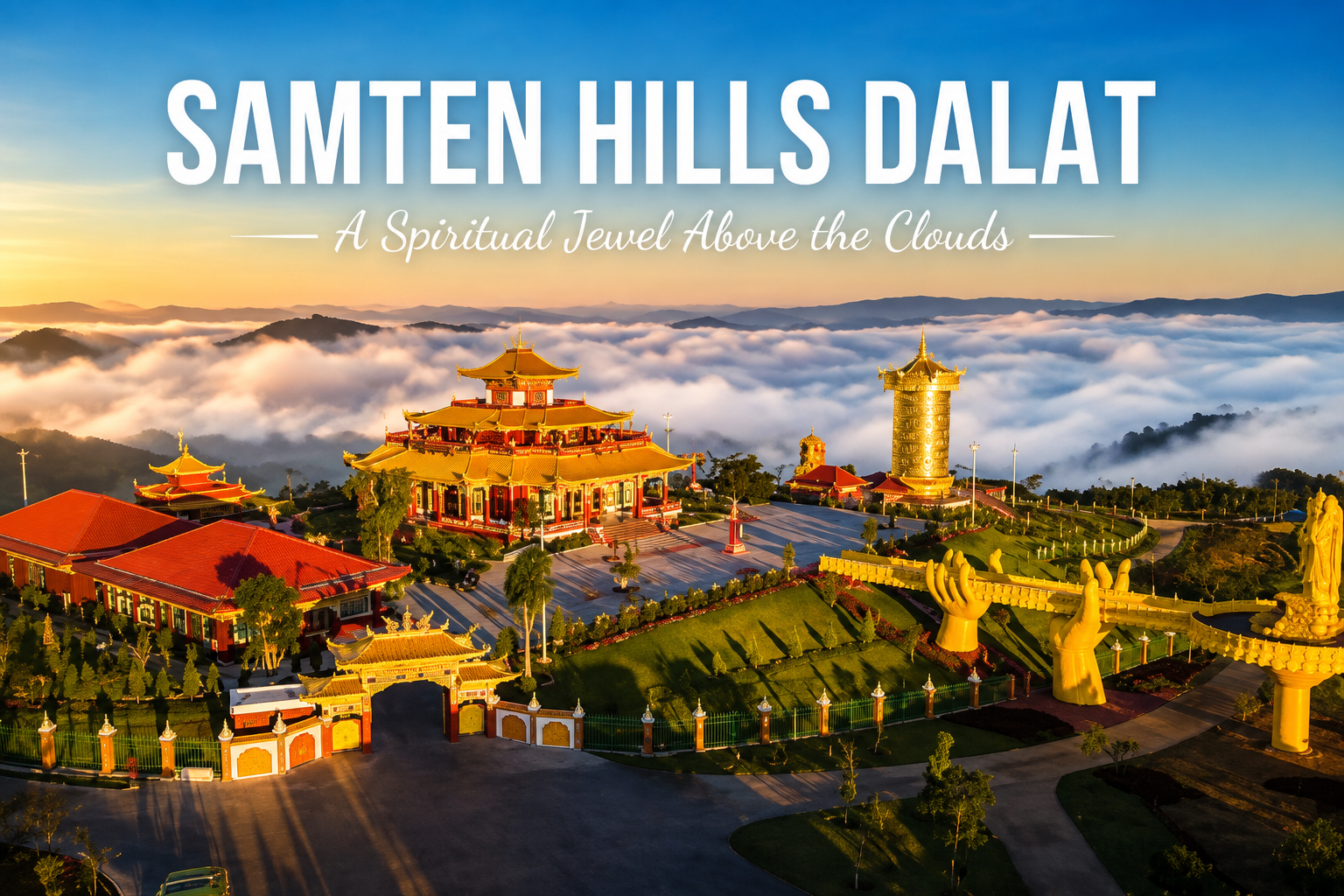
When people see Samten Hills Dalat today, with its impressive Buddhist architecture, large prayer wheel, sculptures, gardens, and mountain surroundings, it is difficult to imagine what the place looked like when I first worked there in May 2021.
At that time, Samten Hills was not yet the beautiful destination that visitors know today. It was still a construction site, with buildings gradually taking shape, artists working on sculptures and paintings, and construction workers busy almost every day. I was there not as a tourist or a tour guide, but as an English–Vietnamese interpreter, working closely with a foreign architect.
For me, it was one of the most unusual jobs I have ever had.
It also happened during one of the most unusual periods of my life.
When Tourism Suddenly Stopped
In 2020 and 2021, the COVID-19 pandemic changed almost everything.
For someone working in inbound tourism like me, the change was particularly dramatic. International visitors could no longer travel normally, borders were closed, tours disappeared, and the tourism industry remained quiet for a long time.
Like many people in the industry, I had to find another way to live and work.
Some people left the cities and returned to their hometowns in the countryside. Others stayed safely at home. Some had nothing to do, while others tried to find temporary jobs or completely different types of work.
I was no exception.
I had spent years working as a tour guide, but suddenly there were no international tourists to guide.
So I started looking for something else.
My First Job During the Tourism Shutdown: Grab Driver
Before I eventually went to Dalat, I spent several months working as a Grab driver in Ho Chi Minh City.
At that time, app-based motorbike transportation was still relatively new in Vietnam, and driving for Grab could provide a reasonable income.
A few of my close friends were also tour guides who had suddenly found themselves without tours. So four of us decided to give it a try.
I still remember our routine.
Early in the morning, we would leave home and meet at a coffee shop first. We would sit together, have a drink, and talk about what was happening in our lives.
Then we would put on our Grab uniforms, turn on the Grab app, take the required identification photo, and get ready to start working.
Around lunchtime, we would take off the uniforms, have lunch, and sit together again for another coffee and conversation.
Then it was time to put the uniforms back on and continue working in the afternoon.
Looking back now, it was actually a memorable period of my life.
We were all professional tour guides, but there were no tourists.
So we became motorbike drivers.
It was not necessarily the career path any of us had imagined, but it helped us earn some income and, perhaps just as importantly, gave us something useful to do during a very difficult period.
We did this for several months.
Then another unexpected opportunity appeared.
An Unexpected Phone Call
A friend introduced me to a job as an English–Vietnamese interpreter.
After an interview, I was accepted.
The new job was at a construction site in the Central Highlands, not far from Lien Khuong Airport and Dalat.
I had never worked as a construction-site interpreter before.
I had been a tour guide for years, so I was used to talking to travelers, explaining destinations, and dealing with travel arrangements. But working with an architect and a construction team was something completely different.
Still, I was curious.
And during COVID, opportunities were not something I wanted to turn down easily.
So I packed my things and left Ho Chi Minh City for Dalat.
That was the beginning of another unexpected chapter in my career.
My Time at Samten Hills
I worked at what is now Samten Hills Dalat for about a month and a half.
At that time, the project was still in its early stages.
The place had nowhere near the finished appearance visitors see today. Only some buildings were beginning to take shape, while the main temple and the large prayer-wheel stupa were becoming more recognizable.
Construction was happening every day.
Artists were also working on sculptures and paintings, creating the decorative and spiritual elements that would eventually become an important part of the site.
My role was to work as an English–Vietnamese interpreter, mainly supporting communication between the foreign architect and the Vietnamese side.
I was living in accommodation provided for the staff together with an older colleague who worked as a Chinese–Vietnamese translator. Every morning, we travelled to the construction site, worked throughout the day, and returned in the late afternoon.
It was a very different daily routine from guiding tourists.
Seeing Samten Hills Before It Became a Tourist Attraction
One of the most interesting things about that job was that I could see the project before it became what it is today.
When I was there, Samten Hills was still taking shape.
There were construction materials, workers, unfinished buildings, and ongoing artistic work everywhere.
But I had something that most visitors would never have had at that stage.
I had access to the complete design plans.
Because I worked closely with the architect, I could see what the whole project was supposed to become.
Even though the site itself did not yet have a clear final form, the drawings showed the bigger picture.
I could imagine where the buildings would stand, how the different parts would connect, and how the entire site would eventually look.
That gave me a strange feeling.
Standing in the middle of what looked like a large construction site, I could already imagine the finished destination.
And I remember thinking:
This place is going to become a famous attraction one day.
At the time, I could not know exactly how successful it would become.
But I believed the potential was there.
Today, when I see photographs of Samten Hills and how beautiful the completed site has become, I sometimes think back to those days in 2021.
I feel quite lucky that I had the opportunity to see it from the beginning.
My Work Was Not Only About Translation
Working as an interpreter did not mean sitting in an office translating documents all day.
A construction site is a busy environment.
There were architects, workers, artists, and different teams working at the same time.
Communication had to happen quickly and clearly.
Sometimes I needed to help explain what the architect wanted to the Vietnamese team.
At other times, I needed to help the architect understand what the workers were doing or what was happening on the Vietnamese side.
It was practical, everyday communication.
That experience also taught me that professional interpreting requires more than knowing English and Vietnamese.
You need to understand the situation.
You need to listen carefully.
And you need to make sure that the person receiving the message understands what is actually meant.
My years as a tour guide helped me a lot with that.
A Tour Guide Working at a Construction Site
There was another interesting side to the experience.
I had spent years showing foreign visitors around Vietnam, but now I was working behind the scenes at a place that tourists had not yet come to visit.
I was seeing a destination before the destination existed.
That was fascinating for me.
As a guide, I usually arrive after a place is finished and explain its history, architecture, or culture to visitors.
At Samten Hills, I was watching the story being created.
I could see construction workers building it.
I could see artists creating sculptures and paintings.
I could see the architect’s ideas gradually becoming real structures.
It gave me a different understanding of how a tourist attraction is actually created.
Discovering the Countryside Around Samten Hills


Although my main reason for being in Dalat was work, I did not want to spend all my free time staying inside the accommodation.
I have always enjoyed exploring.
So whenever I had the opportunity, I would drive around the surrounding countryside with my camera and take photographs and videos.
The Central Highlands looked very different from my hometown in the Mekong Delta.
I grew up with the landscape of the Delta—flat land, rivers, canals, and rice fields.
Around Dalat and the surrounding Central Highlands, everything felt different.
There were mountains and hills, winding roads, pine forests, and plantations.
I saw coffee, tea, avocados, carrots, flowers, and many other crops growing across the countryside.
Even the weather felt different.
The cool mountain air was something I always enjoyed.
After spending years guiding tours through Dalat, I had seen many of the city’s famous attractions, but usually only briefly. A typical tour might give me enough time for one or two nights before moving on.
This time, I had the opportunity to see the area differently.
I could stop.
I could explore.
I could take photographs.
I could simply drive through the countryside without having to rush back to a tour schedule.
That became one of my favorite parts of this unexpected period.
When the Translation Job Finished
After about a month and a half, my work at the construction site came to an end.
But COVID was still not over.
International tourism had not reopened, and returning to my normal work as a tour guide was still impossible.
I also did not feel that Ho Chi Minh City was the best place for me to stay during that period, especially while the pandemic situation remained uncertain.
So I decided to stay in Dalat.
That decision led to another completely different experience.
From Interpreter to Interior Decorator


After finishing the interpreting job, I found work in Dalat as an interior decorator.
I stayed in the city for several more months, from around July 2021 until February 2022.
My work was with a team of workers who travelled from one construction site to another, helping decorate newly built houses according to the company’s assignments.
Again, it was completely different from tourism.
But I actually enjoyed it.
And there was one major advantage.
I was still in Dalat.
Instead of arriving with tourists, staying for one or two nights, and then leaving, I now had months to experience the city.
Finally Having Time to Experience Dalat
As a tour guide, I had visited Dalat many times.
But before COVID, I usually had a fixed itinerary.
I might visit the Flower Garden, a pagoda, a waterfall, a palace, or another attraction, then take my travelers to the next destination.
I rarely had enough time simply to explore.
Now I did.
I could drive around the city and surrounding countryside during my free time.
I could watch the changing seasons.
I could stop to photograph flowers.
And one of the most beautiful memories was seeing the cherry blossoms of Dalat.
Dalat Cherry Blossom Season
During the blooming season, cherry blossom trees can add a beautiful touch of pink to streets, hillsides, and areas around the city.
I recorded some of these scenes while travelling back and forth to work in January 2022.
The route included areas around Hung Vuong Street, National Road 20, Trai Mat, and towards Cau Dat.
What made it special was that I was not there as a tourist.
I was simply travelling to work.
Yet I could stop and appreciate the scenery.
That is one of the unexpected gifts of having more time in a place.
You begin to notice things that you might normally miss.
The cherry blossom season is relatively short, so anyone planning to photograph them should check the local conditions carefully rather than relying only on a fixed calendar date.
Looking Back at a Difficult but Valuable Period
When I think about 2021 now, I do not remember it only as the year when tourism stopped.
I remember it as a year when I learned how adaptable life can be.
I was a tour guide.
Then I became a Grab driver.
Then an English–Vietnamese interpreter at a construction site.
Then an interior decorator.
All of those jobs were different, but each one gave me something.
The Grab job helped me earn an income when tourism had disappeared.
The interpreting job allowed me to use my English in a completely different professional environment.
The construction site introduced me to a project that I could watch developing from its early stages.
And working in Dalat for several more months gave me the chance to experience a city that I had previously only known through short tour visits.
Seeing Samten Hills Today


Today, travelers can visit the completed site, admire its architecture, and enjoy the mountain surroundings.
But my memory is of something very different.
I remember the construction site.
I remember the workers.
I remember the artists working on sculptures and paintings.
I remember the architect’s plans.
And I remember standing there and thinking that one day this place would become something special.
It is satisfying to see that vision become reality.
I feel fortunate to have been a small part of that story, even if my role was only for a short period.
A Different Kind of Travel Experience
This period also reinforced something I have always believed about travel.
You do not always have to be a tourist to discover a place.
Sometimes you understand a destination better by living and working there.
During my time in Dalat, I saw the Central Highlands from a different perspective.
I explored villages and countryside roads.
I saw plantations, flowers, forests, and mountain landscapes.
I met people outside the tourism industry.
And I experienced daily life instead of simply following a sightseeing schedule.
That experience has stayed with me.
A Hard Period That Taught Me Something
The COVID period was difficult for many people in tourism, but it also gave me something I had rarely had before: time to stop and think about my career.
Before the pandemic, I was always moving.
One tour finished and another began.
There were airport transfers, hotel check-ins, sightseeing, meals, buses, and flights.
Suddenly, that rhythm disappeared.
Working at Samten Hills gave me a chance to do something different while still using the skills I had developed through tourism.
It also reminded me that my career did not have to be limited to one job title.
I was a tour guide, but I was also a communicator.
I spoke languages.
I understood international travelers.
I knew how to work with people.
Those skills could take me into other areas.
Final Thoughts
My time at Samten Hills lasted only about a month and a half, but it became one of the most interesting chapters of my working life.
I arrived there during a difficult period when international tourism had almost completely disappeared.
I did not know that I would one day look back and see that I had worked at what would become a well-known tourist destination.
At the time, I simply needed a job.
But I also discovered something else.
I discovered more of the Central Highlands.
I had time to explore Dalat.
I experienced a different profession.
And I learned that even when the normal road is closed, there may still be another road ahead.
For me, that is one of the best things about life and travel.
Different places bring different experiences, and sometimes an unexpected journey becomes one of the stories you remember for years.
My Videos From This Period
These videos fit the story naturally and would make good supporting material inside the article:
- Samten Hills / construction-site memories: Watch the video on YouTube
- Dalat cherry blossom season: Watch the Dalat Cherry Blossom video
- Ka Don – Central Highlands: Watch the Ka Don video
- Ta Nung / Dalat countryside: Watch the Ta Nung video
- Another memory from the Central Highlands: Watch the video
Translation Is Part of My Life Between Tours
Tour guiding remains my main profession, but translation and interpreting are also important parts of my working life.
When I have free time, especially during the low tourism season, I am happy to take translation and interpreting assignments.
Sometimes I translate documents.
Sometimes I interpret on-site.
If You Need a Khmer–Vietnamese-English Interpreter
If you are a Vietnamese traveller, family, businessperson, or company that needs Khmer–Vietnamese-English interpreting in Cambodia, I am happy to discuss the assignment whenever I am available.
I can potentially help with situations such as:
- Hospital visits and communication
- Business meetings
- Construction-site communication
- Travel between Vietnam and Cambodia
- On-site interpreting
- General Khmer–Vietnamese communication
- Document-related communication
- Assistance for Vietnamese visitors who are unfamiliar with Cambodia
I cannot guarantee availability because tour guiding remains my main work, but when I am free, I am happy to consider the assignment.
If you need this kind of service, you can contact me through The Son Mekong and tell me what you need, where you need it, and when.
Thank you very much.